Sunday, October 25, 2015

5) Digitization of History of Health Sciences Materials

Images from the History of Medicine (IHM) - NIH/NLM
By: Patrick Corcoran, MLIS candidate, University of Southern Mississippi


Historic Postcard Saline Eye Drops Advertisement (NIH,2014, Digital gallery)


   The U.S. National Library of Medicine (NLM) has created one of the most extensive history of health sciences digitization program in the world.
Located at the National Institutes of Health in Bethesda, Maryland, [the NLM] has been a center of information innovation since its founding in 1836. The world’s largest biomedical library, NLM maintains and makes available a vast print collection and produces electronic information resources on a wide range of topics that are searched billions of times each year by millions of people around the globe. It also supports and conducts research, development, and training in biomedical informatics and health information technology. In addition, the Library coordinates a 6,000-member National Network of Libraries of Medicine that promotes and provides access to health information in communities across the United States.                          (NIH, 2015, About)
In addition to this impressive self-description, the NLM maintains enormous digital and physical repositories concerning the history of medicine.  In tandem with this vast repository of knowledge, the NLM shows great interest in bringing the past alive in showing how pertinent past medical theory and practice can impact the future of the healing arts.  The NLM Web site maintains one of the most extensive linked networks of listed medical and associated field libraries.
   "Digital Collections is the National Library of Medicine's free online resource of biomedical books and videos. All of the content in Digital Collections is freely available worldwide and, unless otherwise indicated, in the public domain. Digital Collections provides unique access to NLM's rich resources" (NIH, n.d., Digital collections).  Using mostly open source technologies, the NLM depends on a myriad of partnering organizations to maintain such a large scope and value.  For technical information concerning the digital collections, click here.
   Examples of the digital collections include: medicine in the Americas, 1610-1920; Cholera online, 1817 to 1900; NLM publications and productions; World War 1, 1914-1918; Unique English imprints, pre-1800, tropical diseases motion pictures; the public health film goes to war; and, NIH annual reports.  Online searching can also be done by: subject; author; title; formats; languages; and, dates by range. (NIH, n.d., collections)
   The Web presence of the NLM is a shining example of federal government funds and labor in a concerted effort to preserve and present the history of health sciences to anyone with internet access.

Bibliography


NIH-National Institutes of Health-U.S. National Library of Medicine. (2015). About.
     Retrieved from https://www.nlm.nih.gov/about/index.html

NIH-National Institutes of Health-U.S. National Library of Medicine. (n.d.). Collections.
     Retrieved from http://collections.nlm.nih.gov/#

NIH-National Institutes of Health-U.S. National Library of Medicine. (n.d.). Digital collections.
     Retrieved from https://www.nlm.nih.gov/about/index.html

NIH-National Institutes of Health-U.S. National Library of Medicine. (2014). Digital gallery. Retrieved from


Sunday, October 18, 2015

4) Highlight of a History of Medicine Library

Cushing/Whitney Medical Historical Library
By: Patrick Corcoran, MLIS candidate, University of Southern Mississippi

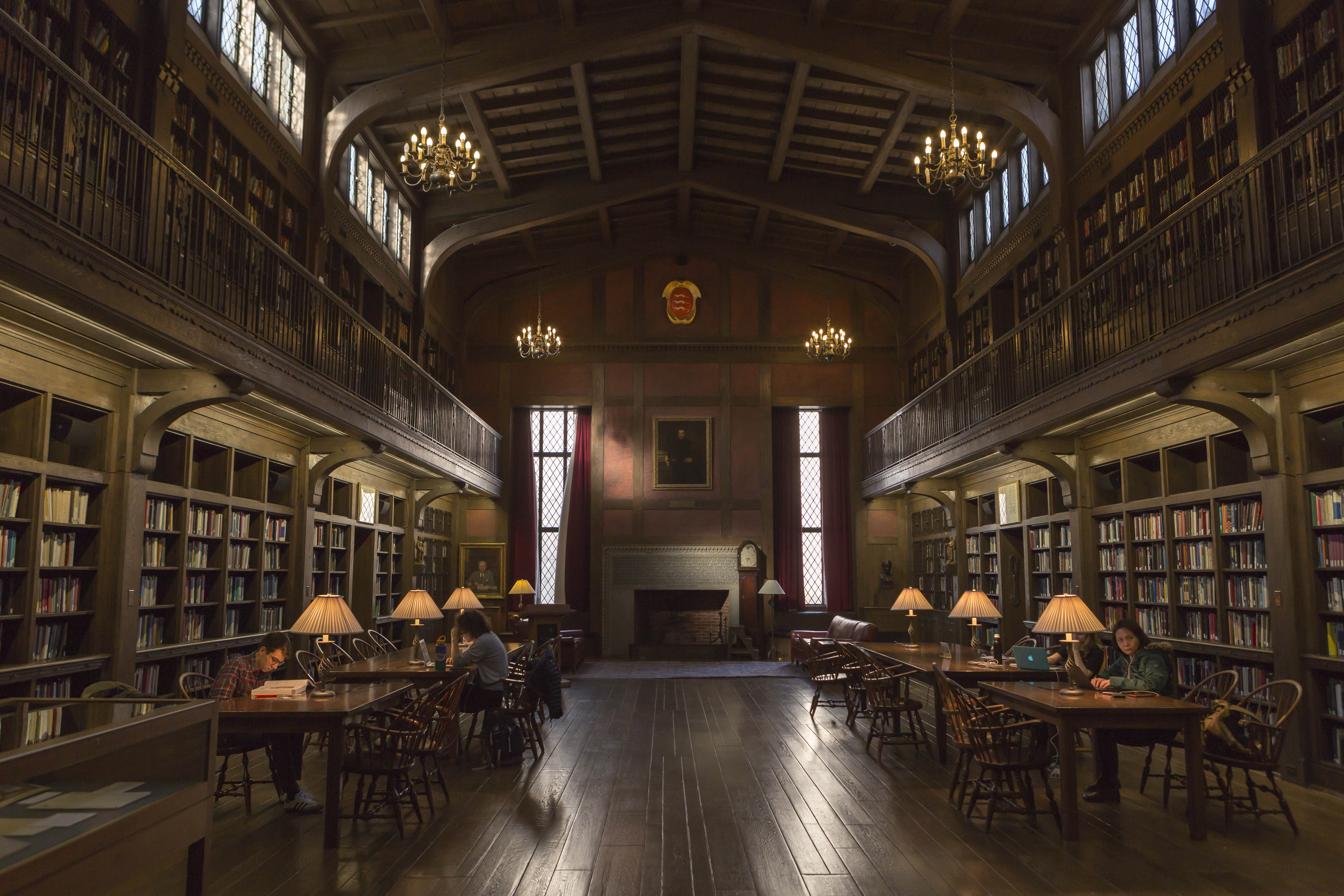
Handsome Reading Room Located on the Campus of Yale University
(Harvey, n.d., Services)


   The Harvey Cushing/John Hay Whitney Medical Library Medical Historical Library, part of Yale Library, is an exquisite example of a specialty repository dedicated to the history of medicine.  The implications of this concept are evolutionary, because it shows the importance of history of health sciences, as we continue to learn healing methods from our past.  Founded in 1941, this collection was the amalgamation of three separate donations. "Special strengths are the works of Hippocrates, Galen, Vesalius, Boyle, Harvey, and S. Weir Mitchell, and works on anesthesia, and smallpox inoculation and vaccination. The Library owns over 300 medical incunabula" (Harvey, n.d., Library).  Incunabula are handwritten books produced before Europe's 16th Century.
   Part of this specialty library is the Cushing Center, which celebrates the achievements of Harvey Cushing, "pioneer and father of neurosurgery" (Harvey, n.d., History).  Cushing, a prolific writer and analyst, created the first brain tumor registry in the world, by collecting brains and slide specimens.  These brains are still an integral part of the collection, in that it now belongs to a historical study which has been surpassed by other collections elsewhere, yet remains the first of its kind.  More anatomic collections have been added, some of which can be viewed digitally, but the following is a video that explains the Cushing Brain Collection in more detail.
Dr. Dennis Spencer, Department of Neurosurgery Chairman, Discusses the Provenance of the Brain Collection                                                                              (Cushing's Brains, n.d.)

Bibliography
             Cushing's Brains. (n.d.). [video]. Retrived from https://youtu.be/U8qpubuSiHw
Harvey Cushing/John Hay Whitney Medical Library Medical Historical Library. (n.d.). History.  
     Retrieved from http://library.medicine.yale.edu/cc/history 
Harvey Cushing/John Hay Whitney Medical Library Medical Historical Library. (n.d.). Library.    
     Retrieved from http://library.medicine.yale.edu/historical/us/library 
Harvey Cushing/John Hay Whitney Medical Library Medical Historical Library. (n.d.). Services.  
     Retrieved from http://library.medicine.yale.edu/historical/do 


Sunday, October 11, 2015

3) Highlight an Archives of Medicine

The Alan Mason Chesney Medical Archives
By: Patrick Corcoran, MLIS candidate, University of Southern Mississippi

Johns Hopkins Hospital, circa 1906. One of the many materials from this institution's medical archives.                                                                                                                                                  (Vashti Bartlett, n.d.)

     The Alan Mason Chesney Medical Archives is a mandated institution of the Johns Hopkins Medical Institutions.  These institutions include: Johns Hopkins Hospital; Johns Hopkins University School of Medicine; Johns Hopkins University School of Nursing; and, Johns Hopkins Bloomberg School of Public Health.  The function of this medical archives is to document "education, research, and healthcare delivery...governance and administration...lives of faculty, staff, and alumni...[and]...cultural properties...." (Alan, n.d., Homepage) of the Johns Hopkins Medical Institutions.  The major objectives of the archives is to: "collect and preserve records and cultural materials critical to the legacy and ongoing operations of the Johns Hopkins Medical Institutions [and to] promote access to collections for use as primary resources in research and education" (Alan, n.d., Homepage).
   Services provided by this archives is: reference and research assistance; reproductions & permissions; genealogy and family history; on-site research; image and film researchers; records management; cultural properties management; and, exhibits (Alan, n.d., Services).  Collections include: institutional records; personal papers collections; biographical files; photographic collections; moving image collections; and, material culture collections (Alan, n.d., collections).  The digital search engine is accessible for the general public and allows for detailed searches, as well as the option to save results.  Access to the collections is through MedArchives OnCall or by visiting the archives in person.
   The manifestation of the Alan Mason Chesney Medical Archives shows the vital importance of medical history preservation and digital access to, both, the present and future.


Bibliography
Alan Mason Chesney Medical Archives of The Johns Hopkins Medical Institutions. (n.d.). Collections.
     Retrieved from http://www.medicalarchives.jhmi.edu/collections.html

Alan Mason Chesney Medical Archives of The Johns Hopkins Medical Institutions. (n.d.). Homepage.

Alan Mason Chesney Medical Archives of The Johns Hopkins Medical Institutions. (n.d.). Services.

Vashti Bartlett: A Hopkins Nurse on a Global Mission. (n.d.). 

Sunday, October 4, 2015

2) Highlight of a Library of Medicine

Johns Hopkins Sheridan Libraries & University Museums
By: Patrick Corcoran, MLIS candidate, University of Southern Mississippi


"The central second floor lobby, between the East and West Reading Rooms, has areas for 
study or relaxation and hosts displays for the Institute of the History of Medicine."   (Welch, 2015)


   The Johns Hopkins medical institution, headquartered in Baltimore, Maryland, maintains, an impressive, four libraries, three regional resource centers, and one museum.  Their specialty library departments include: Center for Educational Resources; Conservation & Preservation; Data Management Services; and, Entrepreneurial Library Program.  The Welch Medical Library is the component of this school which will be highlighted in this blog.
   The Welch Medical Library was built in 1929 and named after the first Dean of the Johns Hopkins School of Medicine, William H. Welch.  "On-site stacks hold thousands of books, journals, and other print materials. Additional print materials are maintained off-site and can be requested in-person at the Welch Services Center on the lower level or electronically using the Library Catalog (Catalyst)" (Welch, 2015).  In addition, the library offers interlibrary loan services, classes, electronic resources, and course reserves.
   This library is also the headquarters for the Institute of the History of Medicine. The collection contains around 40,000 volumes, including over 300 journals and over 100 periodicals.  Ten thousand of these materials are considered rare books, dating back to the 16th Century.  This collection can be searched electronically, yet, currently, the search engines are still under construction.
   Forerunners of 20th Century allopathic medicine, like Johns Hopkins Medical Institutions, continue to produce cutting edge research, in that field.  As this information glut continues to pile up, becoming 'historic' almost immedietely, repositories such as the Welch Medical Library and the Institute of the History of Medicine, become all the more essential to categorize and preserve this vital knowledge.
 

Bibliography
Welch Medical Library. (2015). Retrieved from http://welch.jhmi.edu/welchone/Welch-Library-Building