Sunday, November 29, 2015

10) The Casebooks Project: Medical Digital Repository of Simon Forman and Richard Napier

The Value of Disputed Healing Modalities 
in the Realm of Digital Libraries
By: Patrick Corcoran, MLIS candidate, University of Southern Mississippi

   Examples abound of health practices being, either, disregarded or attacked by mainstream medicine, from, both, a historical and contemporary perspective.  Whether accepted or not by the status quo, these methods of healing most likely end up as material culture within archives, libraries or museums of history of medicine or allied health.  How these repositories address such acquisitions is of utmost importance to the holistic empowerment of our modern world.  One such way that a library decided to package and present a particularly controversial collection is demonstrated in "The Casebooks Project: A Digital Edition of Simon Forman's & Richard Napier's Medical Records 1596-1634".  This is a collaboration between Wellcome (Library) Trust, University of Cambridge and Bodleian Libraries at University of Oxford.
   Concerning this project, Director Lauren Kassell writes:

Medical and astrological casebooks were serial records of practice. The term encompasses diaries, the observations into which they were digested, collections of successful cures, and registers of patients, remedies, and diseases. Casebooks derived from multiple traditions and a plurality of motives, converging in imperatives to write things down, which became increasingly prevalent across the spectrum of literate medical practitioners during the seventeenth century. Practitioners explored different methods of recording cases, using them to produce improved medical knowledge, to advertise sound methods, and to document the history of past practices. Forman’s and Napier’s casebooks are unique, but not unusual. Early modern medical records were produced within local medical politics and the broader worlds of paper technologies and epistemic genres. Casebooks document medical practices, but they also shaped them. The processes of producing the records—from jotted notes to printed observations—are as important to the history of medicine as the final product. (Kassell, 2014)

In this excerpt from her article, Kassell captures the essential importance of bringing historic medical records into the Information Age through use of digitization and making them available on the Internet.  She states that these medico-astrological casebooks are "unique, but not unusual", meaning that this type of documented medical material culture exists throughout the repositories of the world.  Librarians, archivists and curators have a critical role to play in this day and age of on-line digital platforms.  Countless health professionals, from many ages, have their research findings stored in dusty boxes only waiting to be brought to light through digital technology, allowing anyone with Internet access to judge for themselves.
   Below is a quick exhibition of Astrologer-Physician Simon Forman, his protege Richard Napier, 'a day in the life' and an example of one client from the casebook pages.  Just as this material is "not unique", as mentioned above, The Casebooks Project is not the only format from which history of medicine materials can be transmitted through use of the Internet.  For all the varied methods of healing, there are many more ways to package and exhibit this data digitally.  This is our challenge as library, archive, museum, information specialists.  Using interest in holistic healing along with information systems, the chronic and acute ailments of our modern society and citizen may be alleviated through the power of knowledge.

"A painting thought to be of Simon Forman, c. 1900 (wood 37.5cm × 23cm), probably based on the portrait of the astrologer by John Bulfinch, engraved by Richard Godfrey, which circulated widely from 1776. -- Wellcome Library, London"                                                                (The Casebooks Project, n.d., Image and Caption)


 Short animation describing the professional world of Forman, as well as, implications of this digital library (The Casebooks Project, n.d., Audiovisual)


"Anatomy of a case".  In this case, written by Richard Napier, Simon Forman's protege. (The Casebooks, n.d., Anatomy)


Bibliography
The Casebooks Project. (n.d.). Anatomy of a case [Image and Caption]. Retrieved  from http://www.magicandmedicine.hps.cam.ac.uk/ui/images/anatomy.jpg

The Casebooks Project. (n.d.). Collection overview. [Audiovisual]. Retrieved from https://youtu.be/yX6fO1m9lUM

The Casebooks Project. (n.d.). Simon Forman? [Image and Caption]. Retrieved  from http://www.magicandmedicine.hps.cam.ac.uk/on-astrological-medicine/about-the-astrologers/simon-forman 

Kassell, L. (2014, Winter). Casebooks in Early Modern England: Medicine, Astrology, and Written Records. Bulletin of  the  History of Medicine, 88(4), Johns Hopkins University Press. pp. 595-625. doi:  10.1353/bhm.2014.0066

Sunday, November 22, 2015

9) Relevance of History of Health Sciences in the Past, Present and Future of Humankind

Why the History of Medicine and Health Sciences Matters and Why Libraries Play a Central Role
By: Patrick Corcoran, MLIS candidate, University of Southern Mississippi


Sixteenth Century Alchemist-Physician, Paracelsus, who, along with a multitude of others of that same profession, before and after him, developed sophisticated and effective medicines.  Now, at the turn of our 21st Century, these systems are beginning to be re-explored, in a style not unlike what brought Medieval Europe into the Renaissance...the mass reevaluation of ancient knowledge.  Libraries and archives of medical and health sciences are where a large portion of these revolutionarily relevant materials currently reside and can be accessed for use.                                                                       (Ritman, n.d., Image)


   History of medicine and related health sciences libraries and archives are becoming founts of knowledge that will aid our global society in healing many of our most chronic ailments.  Knowing this, librarians and archivists are poised to evolve our profession into the Information Age.
Too many people in public health (as in most other fields) believe that history is irrelevant to their particular interests and professional concerns. Historians and those with a historical perspective have the responsibility to prove them wrong by demonstrating the relevance of their insights and analyses...[in fact]...history is not...the exclusive domain of historians.                                                                          (Fee, 2015)
  Ancient knowledge hidden away in overburdened storage stacks may just as well be sealed in an undiscovered Pharaonic Egyptian tomb.  As specialists in the field of health sciences history are able to identify these resources, and make them available, much germane healing knowledge will be brought to light.  Once analyzed and experimented, these medical techniques can be replicated in our modern day.  Ironically, not only the ancient or Medieval medical knowledge evades us; our Industrial Age boom of technology, experiments and patent medicines have mostly been brushed aside into the recesses of specialty libraries, archives and museums, only to be rediscovered to test their efficacy.
   As these techniques and formulas become unearthed to our critical modern perceptions, librarians, archivists and curators will, once again, be monumental in importance with the cataloguing of this information.  In his article "The Alchemy of Turning Fiction into Truth", David Henige, entertains the notion that the Library of Congress does not effectively address the historical factualness of materials when assigning them a classification number.  Henige exemplifies 'ancient alien' theoretical books being cataloged with space travel and Tolkien Middle Earth materials being placed in literature. (Henige, 2008)  As old ways of healing continue being effective, either a cataloger at the Library of Congress or a small, rural branch library may have the ability to categorize it in a way that is advantageous to, both, modern and future society.
   To end with a glimpse of what is possible, exemplifies the Waring Historical Library at the Medical University of South Carolina.  This specialty library was determined to reinvent itself in order to become more integrated in the university as a whole.  In the end,

...the Waring [library/archives] successfully paired traditional archival administration with innovative digital outreach to show that historical collections can be used effectively by alumni affairs, marketing, and development offices for fundraising, recruitment, and promotion. The Waring has shown that a library can be an indispensable campus resource by actively developing new uses for traditional historical materials and innovative ways to deliver those materials.                       (Welch, Hoffius and Fox, 2011)

Again, this is but a taste of what specialty repositories of the history of medicine and allied sciences is capable of.  This Information Age we find ourselves in is allowing for a vast empowerment and evolution of library and information services.  As stewards of this knowledge, librarians and archivists are poised to be the 'information super heroes' who holistically heal the ailments of our global growing pains.


Bibliography

Fee., E. (2015, Feb.). The relevance of public health history. American Journal of Public Health, 105(2). doi:  10.2105/AJPH.2014.302530

Henige, D. (2008, July). The alchemy of turning fiction into truth. Journal of Scholarly Publishing, 39(4). doi: 
 10.3138/jsp.39.4.354

Ritman Library-Bibliotheca Philosophica Hermetica. (n.d.). Paracelsus [Image]. 
 Retrieved from http://www.ritmanlibrary.com/wp-content/uploads/2011/12/onpage-paracelcus.jpg 

Welch, J.M., Hoffius, S.D. and Fox, E.B. (2011, Jan.). Archives, accessibility, and advocacy: A case study of strategies for  creating and maintaining relevance. Journal of the Medical Library Association, 99(1). doi: 10.3163/1536-  5050.99.1.010 

Sunday, November 15, 2015

8) Telemedicine and the Development of History of Health Sciences

History of Telemedicine and Importance of Libraries
By: Patrick Corcoran, MLIS candidate, University of Southern Mississippi


Physician gives a quick example of the importance of telemedicine when helping underrepresented groups, as can also be the case when libraries empower those same people with information access.      (CCHPCA, 2012)


   Telemedicine combines telecommunication technology developed since the mid-20th Century, and, modern medicine skills.  The U.S. National Library of Medicine defines telemedicine as "the use of computers, the Internet, and other communication technologies to provide medical care information to patients at a distance" (NLM, 2015, telemedicine).  The NLM goes on to explain how important this field is for libraries and information technology zones, as, both, stewards and preservers of this burgeoning new mixture of professional fields of study.  Further information can be found under the title of the NLM National Telemedicine Initiative.
   In her paper "Telecommunications and Medicine: The Development of Telemedicine in Improving Access to Health Care in Rural Areas of East Tennessee", Dr. Teresa Welsh uses several examples explaining that point, as well as, concluding "If research results prove the value of this project, that telemedicine from the University of Tennessee Medical center to smaller, rural emergency services can save lives and/or improve the level of health care, then the program may be permanently implemented and expanded to give greater access to trauma care in rural areas" (Welsh, 1999).  Correlations may be drawn betwixt the importance of technology in rural health care, whether it be through a physician or a librarian.  Librarians, generally being the technology and health information "go-to's" of their community, rural communities included, makes telemedicine and libraries obvious allies.
   In addition to telemedicine, the ability to make medical information easily available, on demand, is a matter of life and death.  A personal view of this author is that information, that is being digitized and set out on-line, from historic texts in history of medicine or allied sciences archives, will, one day, be realized as filling in our modern gaps of medical knowledge.  This will assist our global society to, not only gather a more holistic collection of choices for an individual patient, but also help strengthen chronic and acute disease prevention.

Bibliography
CCHPCA-Center for Connected Health Policy. (2012). Telehealth technologies-The tools for 21st century health care.  [audiovisual]. Retrieve from https://youtu.be/azXV5-obOAQ

NLM-National Library of Medicine. (2015). Telemedicine. Retrieved from    https://www.nlm.nih.gov/research/telemedinit.html 

Welsh, T.S. (1999). Telecommunications and medicine: The development of telemedicine in improving access to health  care in rural areas of east Tennessee. Retrieved from http://ocean.otr.usm.edu/~w146169/telemed.htm

Sunday, November 8, 2015

7) Highlight of Professional Journals in the History of Health Sciences

The Journal of the History of 
Medicine and Allied Sciences 

AMBIX: Journal of the Society for the 
History of Alchemy and Chemistry
By: Patrick Corcoran, MLIS candidate, University of Southern Mississippi


--Journal of the History of Medicine and Allied Sciences--
Cover of Recent Issue                                 (JHMAS, n.d.)


--AMBIX-Journal of the Society for the History of Alchemy and Chemistry--
     
Cover of Recent Issue                                 (AMBIX, 2013)


   These two quarterly journals represent many in the specialized world of history of health sciences, therefore can be found in libraries/archives of the history of medicine.  The Journal of the History of Medicine and Allied Sciences may seem more straightforwardly germane to the subject than the Journal of the Society of the History of Alchemy and Chemistry.  However, when pertaining to the latter, the field of alchemy has an inextricable bond, throughout time, with the healing arts.
   The JHMAC describes itself thus:
Started in 1946, the Journal of the History of Medicine and Allied Sciences is internationally recognized as one of the top publications in its field. The journal's coverage is broad, publishing the latest original research on the written beginnings of medicine in all its aspects. When possible and appropriate, it focuses on what practitioners of the healing arts did or taught, and how their peers, as well as patients, received and interpreted their efforts. Subscribers include clinicians and hospital libraries, as well as academic and public historians. (JHMAS, 2015, about)
   An example of a commentary pulled from the pages of this journal, is a wonderful example of why the field of the history of health sciences is needed and, therefore, why repositories and professional organizations are essential in the dissemination of this knowledge and contributors to the medical education history body of knowledge.  Jon Arrizabalaga simply titles his commentary as "Does History Matter? Commentary on 'Making the Case for History in Medical Education', In this, he briefly, yet effectively shows the enormous impact that knowing medical history can help in understanding the present state of affairs, as well as, how it will further empower future medical professionals. (Arrizabalaga, 2015)

   Whilst AMBIX describes itself:
The Society for the History of Alchemy and Chemistry (SHAC) has a long and distinguished history, having first been founded by J.R. Partington (1886-1965), Frank Sherwood Taylor (1897-1956) and Douglas McKie (1896-1967) in 1935. Read more on SHAC’s history here.
Today the Society is managed by a Council of 18 members. The Council normally meets twice a year. It has five officers: Chairman, Secretary, Treasurer, Membership Secretary, and Editor of Ambix. Further roles are carried out by members of Council or by observers at Council. The Annual General Meeting of the Society is held in the Autumn of each year. The Society is registered as a charity with the Charity Commision (registered number 313777) and is governed by its Constitutionwhich was last amended in December 2014.
The Society’s archives have been deposited with the Museum for the History of Science, Oxford University, where they are available for scholars to consult. Its latest trustees annual report and annual accounts are available on this website. (AMBIX, 2013, about)
   An effective and succinct brief history of the organization, on its 75th anniversary, can be found in Peter Morris' departing editorial from 2012. In the AMBIX article, he writes of his decade of experience as editor, how he found the organization and how he hopes he leaves it.  Morris also speaks on his concerns, as well as, how AMBIX has changed over the years. He finishes by asking why chemists have all but stopped submitting articles and then pays homage to the founder of the society. (Morris, 2012)

Bibliography
AMBIX-Journal of the Society for the History of Alchemy and Chemistry. (Feb. 2013). [Image]. 
 Retrieved from http://www.ambix.org/wp-content/uploads/2012/12/amb_rgb_shadow-2.jpg

AMBIX-Journal of the Society for the History of Alchemy and Chemistry. (2013). About.
 Retrieved from http://www.ambix.org/about/

Arrizabalaga, J. Does History Matter? Commentary on "Making the Case for History in Medical Education"
 J Hist Med Allied Sci (2015) 70 (4):653-655. doi: 10.1093/jhmas/jrv017


JHMAS-Journal of the History of Medicine and Allied Sciences. (n.d.). [Image] 
 Retrieved from http://jhmas.oxfordjournals.org/content/70/4.cover.gif

JHMAS-Journal of the History of Medicine and Allied Sciences. (n.d.). [Image] 
 Retrieved from http://jhmas.oxfordjournals.org/content/70/4.cover.gif

Morris, P. T. (2012). Musings from a Departing Editor on the 75th Anniversary of Ambix. Ambix, 59(3), 189-196.  doi:10.1179/174582312X13484746071949

Sunday, November 1, 2015

6) Highlight of an Archives of History of Medicine

Highlight of the Stanford Medical History Center Archives
By: Patrick Corcoran, MLIS candidate, University of Southern Mississippi

Historical Society Journal  (SHS, 2009)


   The Stanford School of Medicine Medical History Center, SUMC, located in Stanford, California, maintains an extensive and diverse archival collection.  SUMC presents a rich segment of its collection in a digitized, on-line format.
   Twenty separate publications, available here, describe the history and cultural implications of the history of medicine at Stanford, with dates of publication ranging from 1912 to 2009.  This same page gives access to 'thousands of images in a variety of formats', with the use of Flickr as a digital medium.  Next on this page of exploration, within this medical history archives', lists a chart of 'publication, broadcast, commercial license fees' for items, containing quantity, academic/501(c)3/commercial use, whose rates range from $25 to $250. (SUMC, 2014)
   The final four categories of items housed within The Stanford School of Medicine Medical History Center, include: personal papers; rare books; institutional records; and, local history resources.  Hyperlinks within each name represented in the personal papers, give access to location, occupied space, extent and provenance, as well as, a descriptive summary.  In regard to the rare books, the collection contains over 7,600 from the 13th Century to present, including: herbals; illustrated anatomies; guides for midwives; historical medical dictionaries; all-the-while, represented in many languages. (SUMC, 2014)  Institutional records include all the associated hospitals and schools, as well as, a student/professional organization.  Hyperlinks allow for an extensive local history resource list, including historical/genealogical societies, archives, and museums.
   Founded in 1858, as "the first medical school in the vast territory between Iowa and the Pacific" (Wilson, 1998), SUMC predates many other 19th Century institutions of healing, including University of Leeds, England, founded in 1874, yet still touting, both, a strong history of scientific scholarship, and a specialist repository of medical/healing art materials.  It is interesting that the ancient European culture has newer institutions than here in the United States.  The overlap may lie in that these types of specialty archives takes significant funding to collect and maintain.  Anyway, the collection at Leeds is well worth a look at, which contains comparatively exciting collections as at SUMC, and is outlined in an in-depth journal article from the British Society for the History of Science.  P. B. Wood and J. V. Golinski title their collection history/description as "Library and Archive Resources in the History of Science and Medicine at the University of Leeds" (Wood & Golinski, 1981).

Bibliography

SHS-Stanford historical society. (2009). Journal.
 Retrieved from https://ia601004.us.archive.org/BookReader/BookReaderImages.php?      zip=/25/items/Pizzo_201312/Pizzo_jp2.zip&file=Pizzo_jp2/Pizzo_0000.jp2&scale=8&rotate=0

SUMC-Stanford University Medical History Center. (2014). Explore SUMC's past.
 Retrieved from: http://lane.stanford.edu/med-history/explore.html

Wood, P.B. & Golinski, J.V. (1981). Library and Archive Resources in the History of Science and Medicine at the  University of Leeds. The British Journal for the History of Science, 14(3), Cambridge University Press. Retrieved  from http://www.jstor.org/stable/4025983


Sunday, October 25, 2015

5) Digitization of History of Health Sciences Materials

Images from the History of Medicine (IHM) - NIH/NLM
By: Patrick Corcoran, MLIS candidate, University of Southern Mississippi


Historic Postcard Saline Eye Drops Advertisement (NIH,2014, Digital gallery)


   The U.S. National Library of Medicine (NLM) has created one of the most extensive history of health sciences digitization program in the world.
Located at the National Institutes of Health in Bethesda, Maryland, [the NLM] has been a center of information innovation since its founding in 1836. The world’s largest biomedical library, NLM maintains and makes available a vast print collection and produces electronic information resources on a wide range of topics that are searched billions of times each year by millions of people around the globe. It also supports and conducts research, development, and training in biomedical informatics and health information technology. In addition, the Library coordinates a 6,000-member National Network of Libraries of Medicine that promotes and provides access to health information in communities across the United States.                          (NIH, 2015, About)
In addition to this impressive self-description, the NLM maintains enormous digital and physical repositories concerning the history of medicine.  In tandem with this vast repository of knowledge, the NLM shows great interest in bringing the past alive in showing how pertinent past medical theory and practice can impact the future of the healing arts.  The NLM Web site maintains one of the most extensive linked networks of listed medical and associated field libraries.
   "Digital Collections is the National Library of Medicine's free online resource of biomedical books and videos. All of the content in Digital Collections is freely available worldwide and, unless otherwise indicated, in the public domain. Digital Collections provides unique access to NLM's rich resources" (NIH, n.d., Digital collections).  Using mostly open source technologies, the NLM depends on a myriad of partnering organizations to maintain such a large scope and value.  For technical information concerning the digital collections, click here.
   Examples of the digital collections include: medicine in the Americas, 1610-1920; Cholera online, 1817 to 1900; NLM publications and productions; World War 1, 1914-1918; Unique English imprints, pre-1800, tropical diseases motion pictures; the public health film goes to war; and, NIH annual reports.  Online searching can also be done by: subject; author; title; formats; languages; and, dates by range. (NIH, n.d., collections)
   The Web presence of the NLM is a shining example of federal government funds and labor in a concerted effort to preserve and present the history of health sciences to anyone with internet access.

Bibliography


NIH-National Institutes of Health-U.S. National Library of Medicine. (2015). About.
     Retrieved from https://www.nlm.nih.gov/about/index.html

NIH-National Institutes of Health-U.S. National Library of Medicine. (n.d.). Collections.
     Retrieved from http://collections.nlm.nih.gov/#

NIH-National Institutes of Health-U.S. National Library of Medicine. (n.d.). Digital collections.
     Retrieved from https://www.nlm.nih.gov/about/index.html

NIH-National Institutes of Health-U.S. National Library of Medicine. (2014). Digital gallery. Retrieved from


Sunday, October 18, 2015

4) Highlight of a History of Medicine Library

Cushing/Whitney Medical Historical Library
By: Patrick Corcoran, MLIS candidate, University of Southern Mississippi

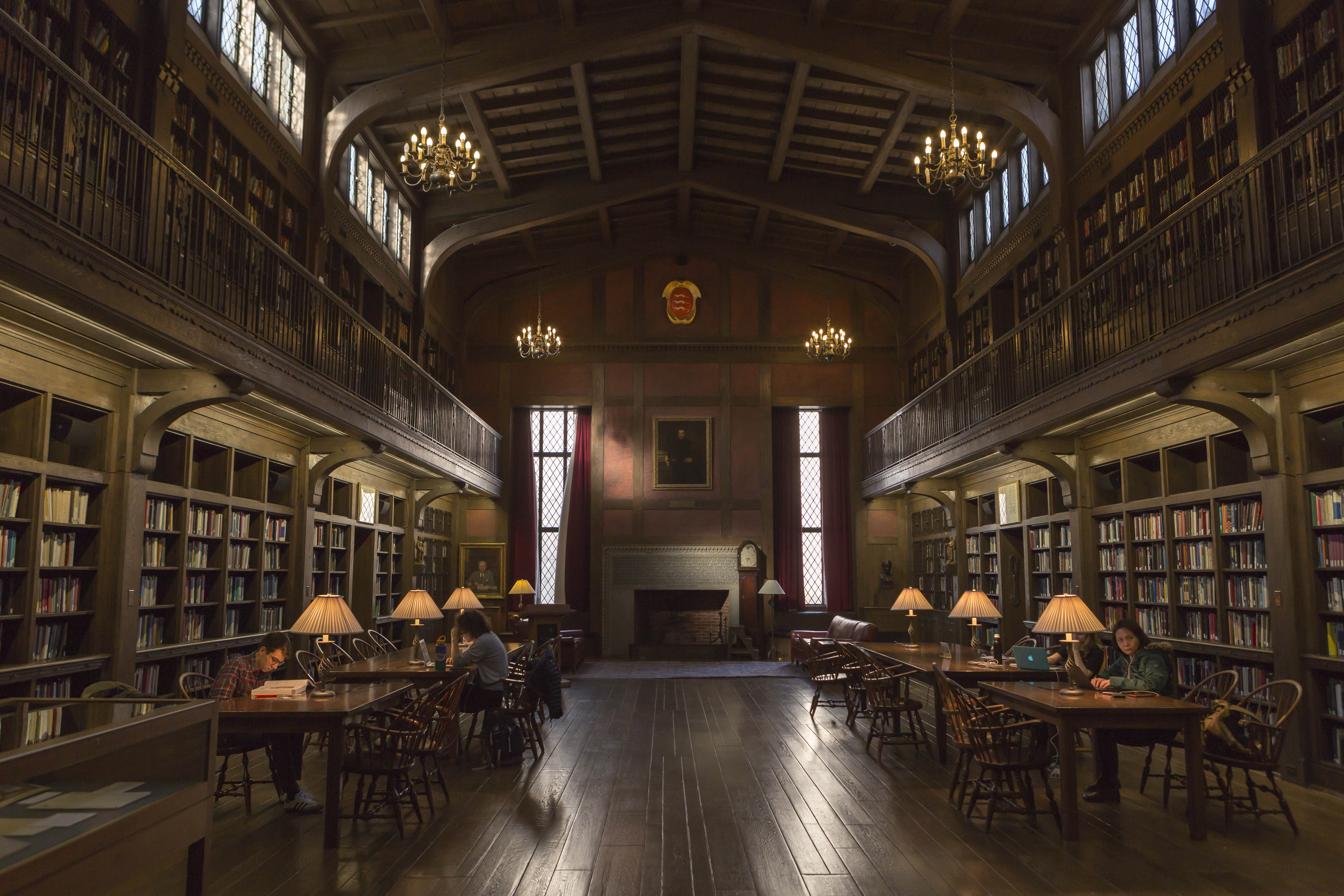
Handsome Reading Room Located on the Campus of Yale University
(Harvey, n.d., Services)


   The Harvey Cushing/John Hay Whitney Medical Library Medical Historical Library, part of Yale Library, is an exquisite example of a specialty repository dedicated to the history of medicine.  The implications of this concept are evolutionary, because it shows the importance of history of health sciences, as we continue to learn healing methods from our past.  Founded in 1941, this collection was the amalgamation of three separate donations. "Special strengths are the works of Hippocrates, Galen, Vesalius, Boyle, Harvey, and S. Weir Mitchell, and works on anesthesia, and smallpox inoculation and vaccination. The Library owns over 300 medical incunabula" (Harvey, n.d., Library).  Incunabula are handwritten books produced before Europe's 16th Century.
   Part of this specialty library is the Cushing Center, which celebrates the achievements of Harvey Cushing, "pioneer and father of neurosurgery" (Harvey, n.d., History).  Cushing, a prolific writer and analyst, created the first brain tumor registry in the world, by collecting brains and slide specimens.  These brains are still an integral part of the collection, in that it now belongs to a historical study which has been surpassed by other collections elsewhere, yet remains the first of its kind.  More anatomic collections have been added, some of which can be viewed digitally, but the following is a video that explains the Cushing Brain Collection in more detail.
Dr. Dennis Spencer, Department of Neurosurgery Chairman, Discusses the Provenance of the Brain Collection                                                                              (Cushing's Brains, n.d.)

Bibliography
             Cushing's Brains. (n.d.). [video]. Retrived from https://youtu.be/U8qpubuSiHw
Harvey Cushing/John Hay Whitney Medical Library Medical Historical Library. (n.d.). History.  
     Retrieved from http://library.medicine.yale.edu/cc/history 
Harvey Cushing/John Hay Whitney Medical Library Medical Historical Library. (n.d.). Library.    
     Retrieved from http://library.medicine.yale.edu/historical/us/library 
Harvey Cushing/John Hay Whitney Medical Library Medical Historical Library. (n.d.). Services.  
     Retrieved from http://library.medicine.yale.edu/historical/do 


Sunday, October 11, 2015

3) Highlight an Archives of Medicine

The Alan Mason Chesney Medical Archives
By: Patrick Corcoran, MLIS candidate, University of Southern Mississippi

Johns Hopkins Hospital, circa 1906. One of the many materials from this institution's medical archives.                                                                                                                                                  (Vashti Bartlett, n.d.)

     The Alan Mason Chesney Medical Archives is a mandated institution of the Johns Hopkins Medical Institutions.  These institutions include: Johns Hopkins Hospital; Johns Hopkins University School of Medicine; Johns Hopkins University School of Nursing; and, Johns Hopkins Bloomberg School of Public Health.  The function of this medical archives is to document "education, research, and healthcare delivery...governance and administration...lives of faculty, staff, and alumni...[and]...cultural properties...." (Alan, n.d., Homepage) of the Johns Hopkins Medical Institutions.  The major objectives of the archives is to: "collect and preserve records and cultural materials critical to the legacy and ongoing operations of the Johns Hopkins Medical Institutions [and to] promote access to collections for use as primary resources in research and education" (Alan, n.d., Homepage).
   Services provided by this archives is: reference and research assistance; reproductions & permissions; genealogy and family history; on-site research; image and film researchers; records management; cultural properties management; and, exhibits (Alan, n.d., Services).  Collections include: institutional records; personal papers collections; biographical files; photographic collections; moving image collections; and, material culture collections (Alan, n.d., collections).  The digital search engine is accessible for the general public and allows for detailed searches, as well as the option to save results.  Access to the collections is through MedArchives OnCall or by visiting the archives in person.
   The manifestation of the Alan Mason Chesney Medical Archives shows the vital importance of medical history preservation and digital access to, both, the present and future.


Bibliography
Alan Mason Chesney Medical Archives of The Johns Hopkins Medical Institutions. (n.d.). Collections.
     Retrieved from http://www.medicalarchives.jhmi.edu/collections.html

Alan Mason Chesney Medical Archives of The Johns Hopkins Medical Institutions. (n.d.). Homepage.

Alan Mason Chesney Medical Archives of The Johns Hopkins Medical Institutions. (n.d.). Services.

Vashti Bartlett: A Hopkins Nurse on a Global Mission. (n.d.). 

Sunday, October 4, 2015

2) Highlight of a Library of Medicine

Johns Hopkins Sheridan Libraries & University Museums
By: Patrick Corcoran, MLIS candidate, University of Southern Mississippi


"The central second floor lobby, between the East and West Reading Rooms, has areas for 
study or relaxation and hosts displays for the Institute of the History of Medicine."   (Welch, 2015)


   The Johns Hopkins medical institution, headquartered in Baltimore, Maryland, maintains, an impressive, four libraries, three regional resource centers, and one museum.  Their specialty library departments include: Center for Educational Resources; Conservation & Preservation; Data Management Services; and, Entrepreneurial Library Program.  The Welch Medical Library is the component of this school which will be highlighted in this blog.
   The Welch Medical Library was built in 1929 and named after the first Dean of the Johns Hopkins School of Medicine, William H. Welch.  "On-site stacks hold thousands of books, journals, and other print materials. Additional print materials are maintained off-site and can be requested in-person at the Welch Services Center on the lower level or electronically using the Library Catalog (Catalyst)" (Welch, 2015).  In addition, the library offers interlibrary loan services, classes, electronic resources, and course reserves.
   This library is also the headquarters for the Institute of the History of Medicine. The collection contains around 40,000 volumes, including over 300 journals and over 100 periodicals.  Ten thousand of these materials are considered rare books, dating back to the 16th Century.  This collection can be searched electronically, yet, currently, the search engines are still under construction.
   Forerunners of 20th Century allopathic medicine, like Johns Hopkins Medical Institutions, continue to produce cutting edge research, in that field.  As this information glut continues to pile up, becoming 'historic' almost immedietely, repositories such as the Welch Medical Library and the Institute of the History of Medicine, become all the more essential to categorize and preserve this vital knowledge.
 

Bibliography
Welch Medical Library. (2015). Retrieved from http://welch.jhmi.edu/welchone/Welch-Library-Building

Sunday, September 27, 2015

1) History of Health Information

An Extremely Brief History of Health Information
By: Patrick Corcoran, MLIS candidate, University of Southern Mississippi


Artist's Interpretation of the Temple of Ascepius, Island of Kos, and early Greek Repository of Health Information                                                                                                                                    (Caton, 1906, pg. 571)


   Health information is a topic that can be traced into antiquity.  In regards to written health information documentation, ancient priestly classes of healers inscribed remedies on clay tablets, papyrus scrolls and rock walls.  This form of writing technology created the first repositories of health information.  The healing temples, which sprouted out of the ancient civilizations, became the next libraries of health information.  Throughout the Middle Ages, the Islamic world flourished, making great strides in many scholastic fields.  Through conquest in the Iberian Peninsula, translations of the ancient medical works were infused into Christian Europe.
   The great secular libraries that arose in the West maintained specialties in health information, as the cloistered Catholic strongholds of cathedral and abbey libraries had contained much of the medical information throughout the Middle Ages.  "Italy led in the establishment of societies" (Birchette, 1973, pg. 305), which consequently led to the aggregation of health related books and materials for the use of members.  "The oldest medical library [in the British American Colonies/United States]...is the Pennsylvania Hospital library (1763). Its first catalog was published in 1790 (Birchette, 1973, pg. 306).  Today, health information specialty libraries are replete in society; history of health information/sciences is a type of specialty library that, although few in number, remain bulwarks of protection, making available millennia of healing knowledge for today and tomorrow's education.
   Health information is as ancient as writing.  It encompasses what we would consider "mainstream allopathic medicine" and all the other parallel medicines that have been practiced over the course of our human existence.  This is a broad topic that has implications of life and death for the individual, therefore, for humanity in general.  I pray that we, as a world of diverse cultures, show much reverence to the libraries and archives which hold this precious lineage of health information, for our future's sake.  For a more detailed history of medical libraries, please click here.
 

Bibliography
Birchette, K. (1973). The history of medical libraries from 2000 b.c. to 1900 a.d. Bulletin of the Medical Library
     Association, 61(3), 302-308. Retrieved from http://www.ncbi.nlm.nih.gov/pmc/articles/PMC198686/ 

Caton, R. (1906). Hippocrates and the newly-discovered health temple of cos. The British Medical Journal, 1 (2358), 
     571-574. Retrieved from http://www.ncbi.nlm.nih.gov/pmc/articles/PMC2380832/